TENGHUI provides hardware insertion services for custom sheet metal parts, enclosures, panels, brackets, chassis, and fabricated assemblies.
Self-clinching nuts, studs, standoffs, rivet nuts, threaded inserts, and blind rivets can be installed according to your drawing and assembly requirements. Each application is reviewed based on the sheet material, thickness, hole dimensions, edge distance, installation direction, and required fastener performance.
✅ All Design Uploads Are Secure & Confidential
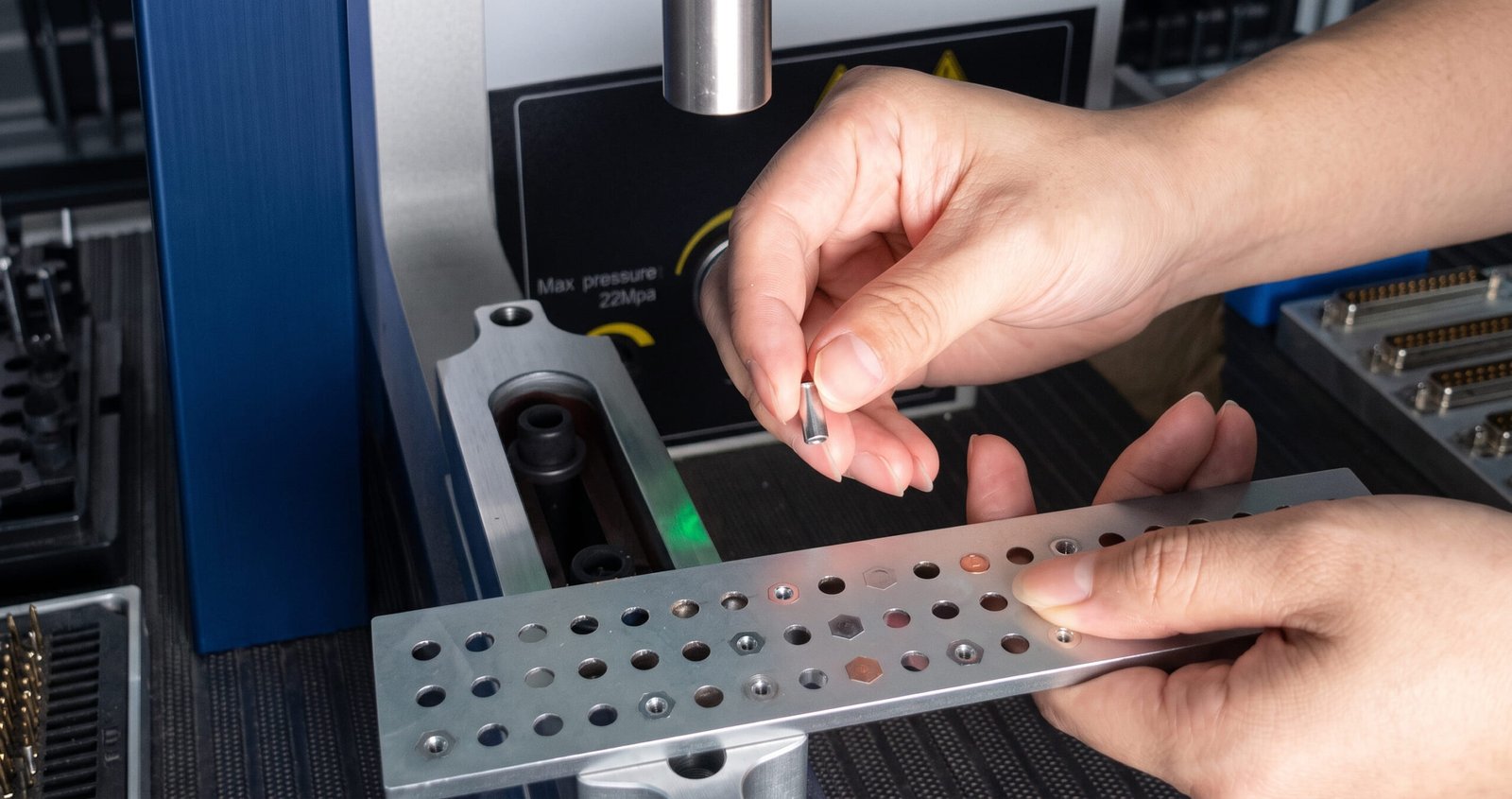
Thin sheet metal often cannot provide enough thread engagement for a reliable tapped hole. Installed hardware creates durable threads, fixed mounting points, or permanent joints without increasing the overall material thickness.
Establish strong, wear-resistant metric or imperial threads directly in thin sheet metal.
Eliminate loose hardware pieces and separate loose assembly components during maintenance.
Streamline assembly steps and speed up integration for operators and technicians.
Ensure precise standoffs, stable mounting points, and accurate component clearance.
Deliver consistent structural reliability across prototypes and high-volume production batches.
Replace complex welding methods with clean mechanical fastening when more suitable.
Professional hardware insertion creates strong, reliable threads and permanent fixing points in thin sheet metal. Review the complete specifications and design requirements for each fastener type below.
Core Function: Create strong, reusable female threads in thin sheet metal. Commonly used in enclosures, control panels, chassis, brackets, and equipment housings.
Design Requirements: The sheet material, hardness, thickness, mounting-hole diameter, and minimum edge distance must match the selected fastener specification.
Core Function: Provide a permanently mounted male thread for attaching components without requiring a separate bolt.
Applications: Suitable for mounting circuit boards, covers, cable brackets, electrical components, and internal assemblies.
Core Function: Create a fixed spacing and threaded mounting point in a single installed component.
Applications: Typical applications include PCB mounting, electronic enclosures, display equipment, control systems, and layered sheet metal assemblies.
Core Function: Provide load-bearing threads in thin sheets, hollow sections, and enclosed parts where conventional tapping is unsuitable.
Accessibility: Because installation can be performed from one side, rivet nuts are useful for cabinets, tubes, frames, enclosures, and assembled structures with limited rear access.
Core Function: Permanently join two or more sheet metal components when access is available from only one side.
Applications: Commonly used for covers, panels, brackets, ducts, cabinets, and lightweight assemblies where welding or removable fasteners are unnecessary.
Fastener selection should be based on the required thread, sheet material, loading condition, assembly method, corrosion environment, and production quantity.
| Hardware Type | Typical Purpose | Important Design Factors |
|---|---|---|
| Self-clinching nut | Reusable female thread | Sheet hardness, thickness, hole size and edge distance |
| Self-clinching stud | Permanently mounted male thread | Stud length, thread size, installation direction and clearance |
| Self-clinching standoff | Fixed spacing and threaded mounting | Standoff height, thread type, sheet thickness and assembly space |
| Rivet nut | Thread in thin or enclosed components | Grip range, hole size, head style, torque and access |
| Blind rivet | Permanent sheet metal joint | Rivet diameter, grip range, material combination and joint access |
Sheet metal assemblies can be manufactured from a wide variety of engineering metals. When different metals are combined in one assembly, material compatibility, welding method, fastener material, surface treatment, and galvanic corrosion should be considered during design review.
| Material | Available Types | Assembly Considerations |
|---|---|---|
| Aluminum | 5052 5754 5083 6061 | Lightweight, corrosion-resistant material widely used for enclosures, brackets, and structural frames. |
| Stainless Steel | SUS301 SUS304 SUS316 | Offers high strength, excellent corrosion resistance, and clean cosmetic finishes for demanding environments. |
| Cold-Rolled Steel | SPCC DC01 DC05 | Features smooth surface quality and good formability, ideal for general panels, trays, and chassis. |
| Carbon Steel | SPHC Q235 Q355 | Cost-effective structural material providing high mechanical strength for heavy-duty assemblies and frames. |
| Electro & Hot-Dip Galvanized Steel | SECC SGCC | Coated with zinc for enhanced corrosion protection while maintaining smooth surface aesthetics. |
| Copper & Brass | Selected applications | Available for applications requiring high electrical conductivity or decorative aesthetic finishes. |
| Titanium | Reviewed projects | Specialized high-performance metal for reviewed prototype and low-volume aerospace or medical projects. |
Following strict design rules for fastener specification, hole preparation, edge distance, and manufacturing sequence ensures optimal structural integrity and retention strength in sheet metal assemblies.
Rigorous inspection protocols ensure every inserted fastener meets strict mechanical and visual standards. Advanced testing options are available upon specification before quotation.
Thread gauging, torque testing, push-out testing, or pull-out testing can be evaluated when these requirements are specified before quotation.
To ensure a fast and accurate hardware insertion quote, please provide complete design and technical documentation. If fasteners are not yet selected, our engineering team can assist with practical fastening options.
Once we receive your design files, our senior manufacturing engineers will manually perform a comprehensive DFM review and deliver an accurate, optimized quote within 24 hours.