High-precision Polycarbonate component manufacturing via 5-Axis CNC Machining, Vapor Polishing, and Precision Injection Molding. Delivering optical clarity, glass-like transparency, extreme impact resistance, and tight tolerances down to ±0.02 mm
✅ All Design Uploads Are Secure & Confidential
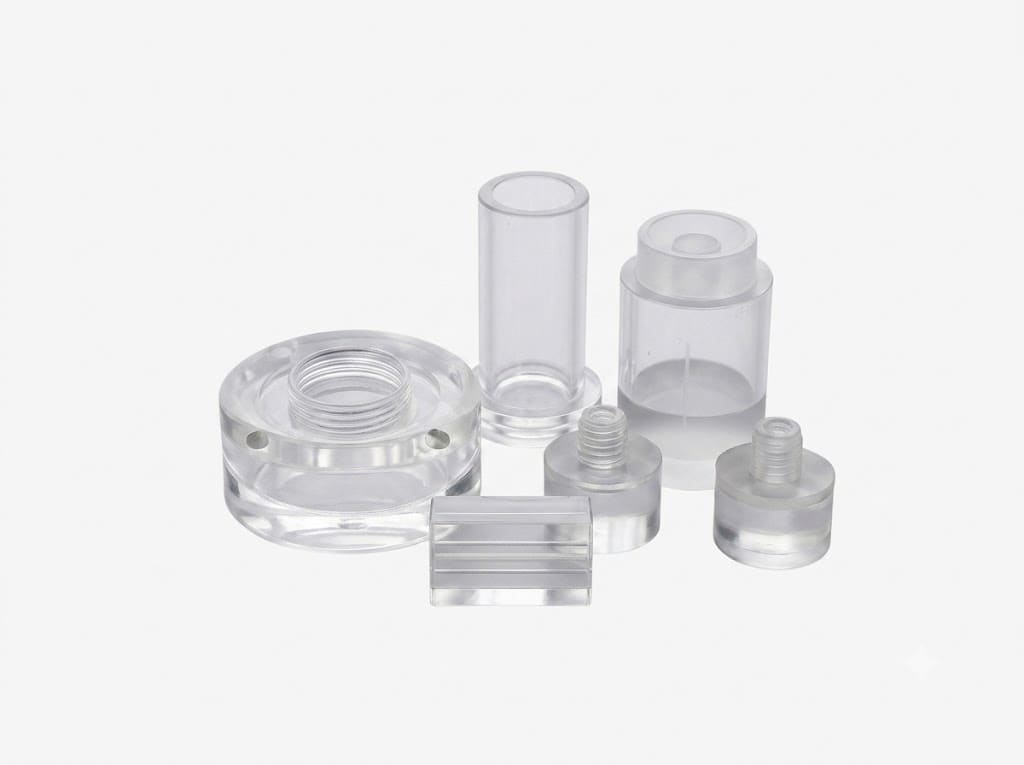
Compare optical transparency, impact toughness, and glass-fiber reinforcement options across clear and structural PC grades.
| Technical Property | Optical Clear PC (Standard) | PC + 20% GF (Reinforced) | Flame-Retardant PC (UL94 V-0) |
|---|---|---|---|
| Light Transmittance | 88 – 90% (Glass-like Clear) | Translucent / Opaque | Translucent / Opaque |
| Density | 1.20 g/cm³ | 1.35 g/cm³ | 1.22 g/cm³ |
| Tensile Strength (Yield) | 60 – 70 MPa | 95 – 110 MPa | 65 – 75 MPa |
| Heat Deflection Temp (HDT) | 130 – 140 °C (266–284 °F) | 140 – 145 °C | 130 – 135 °C |
| Izod Impact Strength | Ultra-High (Unbreakable) | High Stiffness / Moderate Impact | High Impact |
| Flammability Rating | UL94 V-2 / HB | UL94 V-1 / V-0 | UL94 V-0 (Self-Extinguishing) |
| Primary Application | Clear safety shields, lenses, light pipes | Rigid electronic frames, pump bodies | Electrical switch boxes, EV chargers |
From optical-grade crystal clarity to hard-coat scratch protection and UV-resistant treatments.
Polycarbonate is celebrated for combining optical transparency with bulletproof-level impact resistance.
CNC milling leaves a cloudy/frosted surface on clear Polycarbonate. We apply Vapor Polishing (using specialized chemical solvent vapor to smooth surface micro-ridges) or multi-step hand sanding with diamond polishing compounds to restore 100% optical glass-like transparency.
Polycarbonate (PC): Focuses on extreme impact resistance (virtually unbreakable), higher heat deflection (135°C), and flexibility, making it ideal for safety guards and structural covers.
Acrylic (PMMA): Focuses on higher scratch resistance, slightly superior optical clarity, lower cost, and easier flame polishing, ideal for display panels.
Yes! Polycarbonate has a heat deflection temperature of ~135°C. We also offer specialized UL94 V-0 flame-retardant PC grades that self-extinguish within seconds after exposure to open flames, making them mandatory for EV charger enclosures and high-voltage junction boxes.
Raw PC is susceptible to fine hairline scratches. We offer Anti-Scratch Hard Coating (2H–3H hardness) and ship clear parts wrapped in protective peelable PE film or individual anti-static bubble packaging to ensure defect-free optical surfaces upon arrival.
Please upload 3D CAD files in STEP (.stp / .step) or IGES (.igs) format. For clear optical transparency callouts, thread locations, or anti-scratch coating specs, please attach a 2D drawing in PDF or DWG format.
Once we receive your design files, our senior manufacturing engineers will manually perform a comprehensive DFM review and deliver an accurate, optimized quote within 24 hours.