Precision Nylon component manufacturing featuring PA6, PA66, and Glass-Filled Nylon (PA66+GF30) via CNC Machining, Injection Molding, and SLS 3D Printing. Delivering ultra-high toughness, fatigue endurance, and wear resistance with tolerances down to ±0.02 mm.
✅ All Design Uploads Are Secure & Confidential
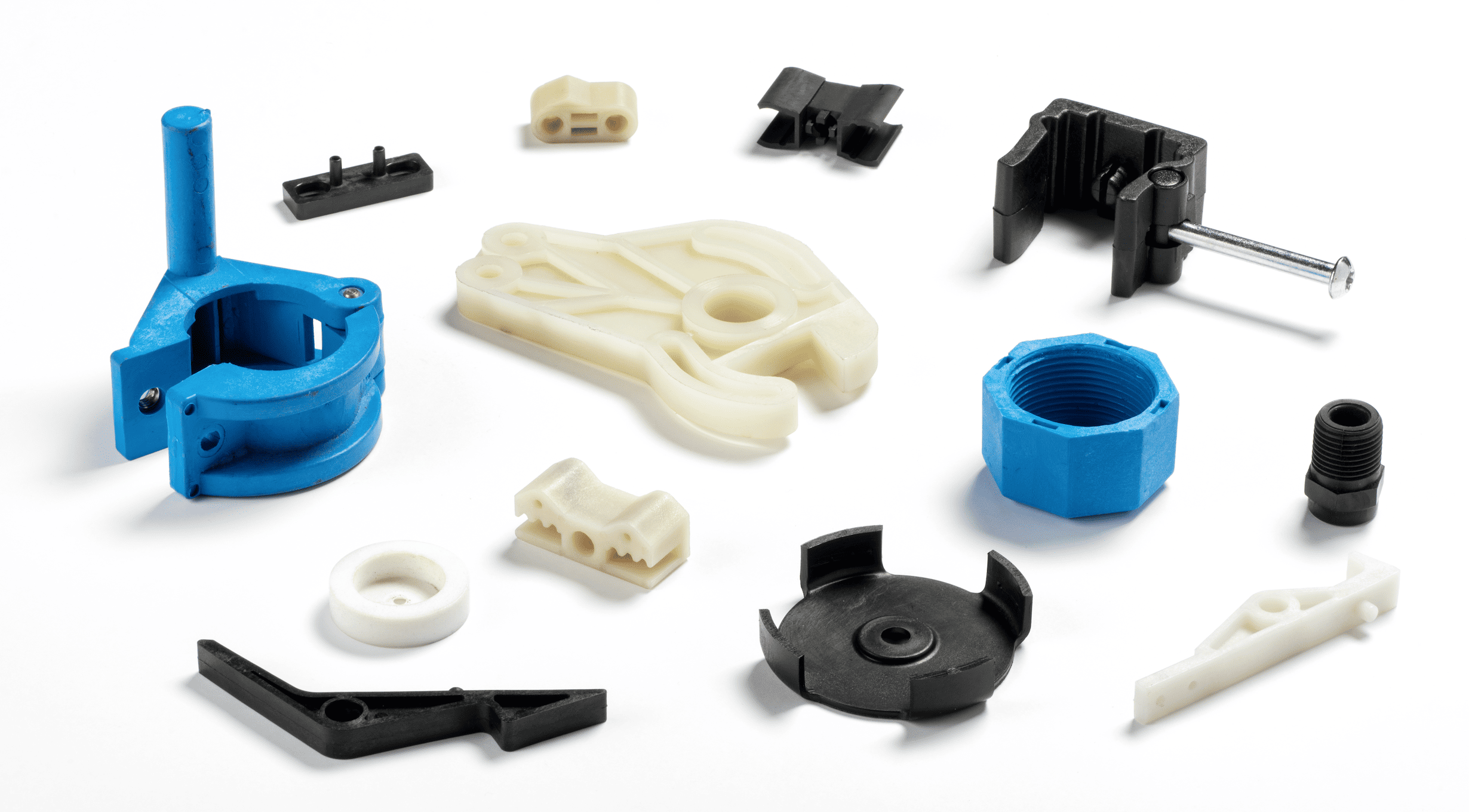
Compare mechanical strength, heat deflection, and glass-fiber reinforcement options across engineering Nylon grades.
| Technical Property | PA6 (Standard) | PA66 (High Hardness) | PA66 + 30% GF (Reinforced) |
|---|---|---|---|
| Density | 1.13 g/cm³ | 1.14 g/cm³ | 1.35 g/cm³ |
| Tensile Strength (Yield) | 75 – 80 MPa | 80 – 85 MPa | 150 – 175 MPa |
| Flexural Modulus | 2.8 GPa | 3.0 GPa | 8.5 – 9.0 GPa |
| Heat Deflection Temp (HDT) | 70 – 80 °C | 90 – 100 °C | 240 – 250 °C (High Heat) |
| Izod Impact Strength | High (Extreme Toughness) | High | Moderate (High Stiffness) |
| Moisture Absorption (24h) | 1.8 – 2.0% | 1.3 – 1.5% | 0.8 – 1.0% |
| Primary Application | General wear pads, rollers | Precision gears, bushings | Structural brackets, automotive housings |
Customize the surface texture, color, and mechanical toughness of your custom Nylon components.
Evaluate the mechanical strength, wear endurance, and moisture behavior of PA (Nylon) alloys.
PA6: Offers the highest impact resistance and dampening, ideal for shock-absorbing rollers and wear plates.
PA66: Harder with higher mechanical stiffness and lower moisture absorption, ideal for precision sliding bushings and drive gears.
PA66+30%GF: Reinforced with 30% glass fibers to vastly boost tensile strength (up to 175 MPa) and heat resistance (HDT up to 250°C), perfect for replacing aluminum structural brackets.
Unreinforced Nylon naturally absorbs ambient humidity (1.5% to 3%), which slightly increases part dimensions (approx. 0.2% linear growth per 1% moisture) while increasing impact toughness. For submerged high-precision fittings, we recommend factoring growth into the CAD design or selecting POM (Delrin) instead.
CNC Machining: Best for 1–500 low-volume parts requiring maximum material density, tight tolerances (±0.02 mm), and heavy wall thicknesses.
SLS 3D Printing (Nylon PA12): Ideal for complex hollow geometries without support structures.
Injection Molding: Best for high-volume mass production (1,000+ parts).
Yes! White or natural Nylon parts excel at accepting hot chemical pigment dyeing, which penetrates the plastic surface to produce permanent black, blue, or red colors without peeling or chipping during heavy wear.
Please upload your 3D CAD files in STEP (.stp / .step), IGES (.igs), or SolidWorks (.sldprt) format. For custom thread callouts, glass-fiber percentage requirements, or critical assembly tolerances, please also attach a 2D PDF drawing.
Once we receive your design files, our senior manufacturing engineers will manually perform a comprehensive DFM review and deliver an accurate, optimized quote within 24 hours.