Skip to content
Custom POM components for automation equipment, instrumentation, and mechanical assemblies. TENGHUI provides in-house CNC milling and turning for prototypes, low-volume orders, and repeat production.
From bushings and rollers to guides and precision spacers, we review material selection, machining sequence, and critical dimensions before production.
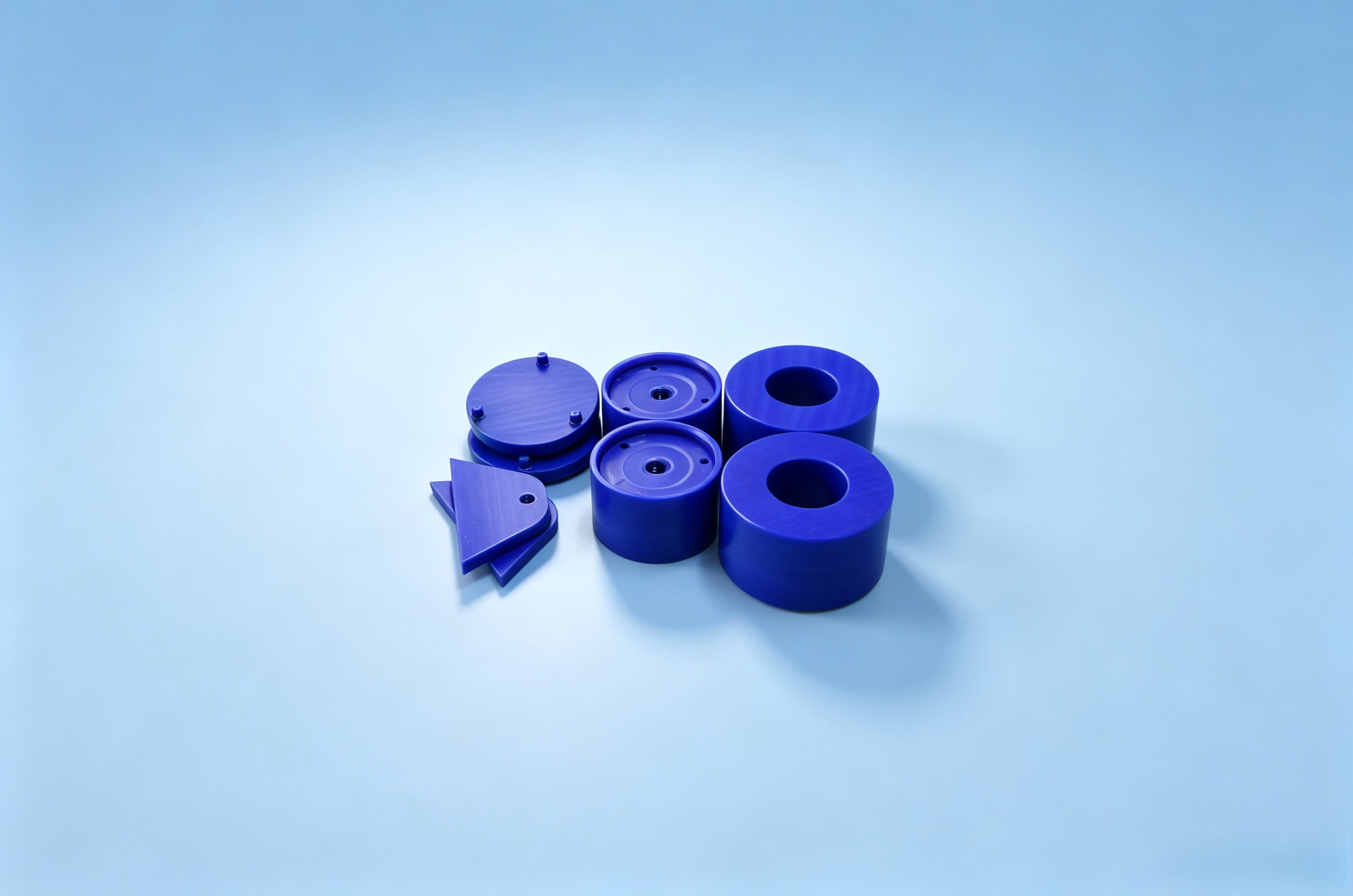
POM, also known as acetal or polyoxymethylene, is an engineering thermoplastic valued for its stiffness, machinability, and low-friction characteristics. The two main types are acetal copolymer (POM-C) and acetal homopolymer (POM-H). Delrin® is a brand of acetal homopolymer, rather than a general name for all POM materials.
| Material Characteristic | General Guidance | What to Specify |
|---|---|---|
| Material Type | POM-C and POM-H offer different balances of mechanical properties and environmental resistance | Required type, brand, grade, and applicable material specification |
| Density | Common unfilled grades are approximately 1.41–1.43 g/cm³ | Use grade-specific data where component weight is critical |
| Strength & Stiffness | Suitable for many lightly loaded mechanical components | Loads, support points, allowable deflection, and service life |
| Friction & Wear | Useful sliding characteristics in suitable operating conditions | Mating material, load, speed, lubrication, and wear requirements |
| Moisture Absorption | Low compared with many common nylon grades, but not zero | Humidity, immersion duration, temperature, and dimensional requirements |
| Heat Performance | Depends on grade, load, exposure time, and geometry | Continuous and peak operating temperatures |
| Dimensional Stability | Generally good for an engineering plastic; thermal expansion and residual stress remain important | Critical fits, flatness, inspection conditions, and assembly requirements |
| Chemical Compatibility | Depends on the substance, concentration, temperature, and exposure | Cleaning agents, fluids, oils, and other contact substances |
*Properties vary by grade, stock form, and processing history. Use the selected material’s data sheet for engineering assessment. Heat deflection temperature should not be treated as a universal continuous-use temperature.
Understanding the key differences between Acetal Copolymer and Acetal Homopolymer helps ensure component reliability across varied thermal, chemical, and mechanical environments.
Commonly selected for general machined components. It typically offers low centerline porosity and useful resistance to moisture and a range of chemicals. Suitability for hot water or chemical exposure still requires grade-specific review.
Often considered where higher stiffness, strength, or fatigue performance is important. Thick-section stock may require additional attention to centerline porosity, particularly for sealing or fluid-handling components.
POM components are often used with an as-machined finish. Secondary operations should be selected according to function, appearance, and dimensional requirements.
Parts retain visible machining marks without an additional decorative treatment. This is a practical option for many bushings, guides, rollers, and internal mechanical components.
Accessible edges are deburred according to the drawing and agreed requirements. Particular attention can be given to hole exits, slots, threads, and assembly features.
Cleaning methods are selected to suit the material, machining residues, and intended use.
A matte texture may be evaluated for selected cosmetic surfaces. The process and achievable appearance depend on geometry, material, and sample approval.
Part numbers, orientation marks, or other identification can be reviewed where required. The marking method, contrast, durability, and location depend on grade, color, and surface.
POM is a practical option for many mechanical components where a combination of stiffness, low friction, and machinability is required.
POM is the material family, also called acetal. POM-C is acetal copolymer, while POM-H is acetal homopolymer.
Delrin® is a brand of acetal homopolymer. It should not be used as a generic description for all acetal materials.
Specify the required type and exact grade where material identity is important. If the material is undecided, share the operating requirements for an initial manufacturing review.
POM has relatively low moisture absorption, making it a useful option for many components exposed to humidity or water.
However, it does absorb some moisture, and dimensional changes remain possible. Suitability depends on the grade, exposure duration, temperature, chemicals, and required fit.
Long-term immersion and close-tolerance assemblies should be evaluated under representative conditions.
Tolerances are confirmed after reviewing part dimensions, geometry, stock condition, and service requirements.
Small, well-supported features may permit tighter tolerances than large, thin-walled, or asymmetric components. Temperature, clamping, and time after machining can also affect measurements.
Mark critical dimensions, fits, flatness, and inspection requirements on your drawing so achievable limits can be agreed before production. Threads and gear features should include the applicable specifications rather than a single general tolerance.
We plan stock selection, workholding, material removal, and machining sequence around the part geometry.
For parts sensitive to movement, staged roughing and finishing with time between operations may be used. Thermal stress-relief treatment can be evaluated where appropriate, following guidance for the selected stock material.
These methods help manage deformation but do not eliminate the effects of temperature, loading, or long-term service conditions.
Standard painting and adhesive bonding are difficult because POM has low surface energy.
Mechanical fasteners, suitable inserts, or designed assembly features may provide more practical solutions. If bonding or painting is essential, the surface treatment, adhesive or coating, and required durability must be evaluated together.
Do not assume that a successful appearance sample will provide adequate structural bond strength.
In some applications, POM can replace a metal part to reduce weight or provide different friction and noise characteristics.
The decision requires review of loads, stiffness, temperature, wear, creep, dimensional changes, and assembly methods. A metal design should not be transferred directly to plastic without checking these requirements.
Straightforward CNC prototypes can often be completed in approximately 3–7 working days.
Larger quantities, complex geometries, staged machining, special materials, and inspection requirements may need additional time. We confirm the delivery plan after reviewing your files and project requirements.
Please provide:
For gears or sliding components, include the relevant geometry, mating conditions, and performance requirements.
Upload your 2D drawings (PDF/DWG/DXF) and 3D CAD files (STEP/IGES). We evaluate part geometry, materials, and tolerances within 24 hours.
Once we receive your design files, our senior manufacturing engineers will manually perform a comprehensive DFM review and deliver an accurate, optimized quote within 24 hours.