1. Home
  2. »
  3. Sheet Metal Fabrication Services
  4. »
  5. Sheet Metal Hardware Insertion Services

Sheet Metal Hardware Insertion Services

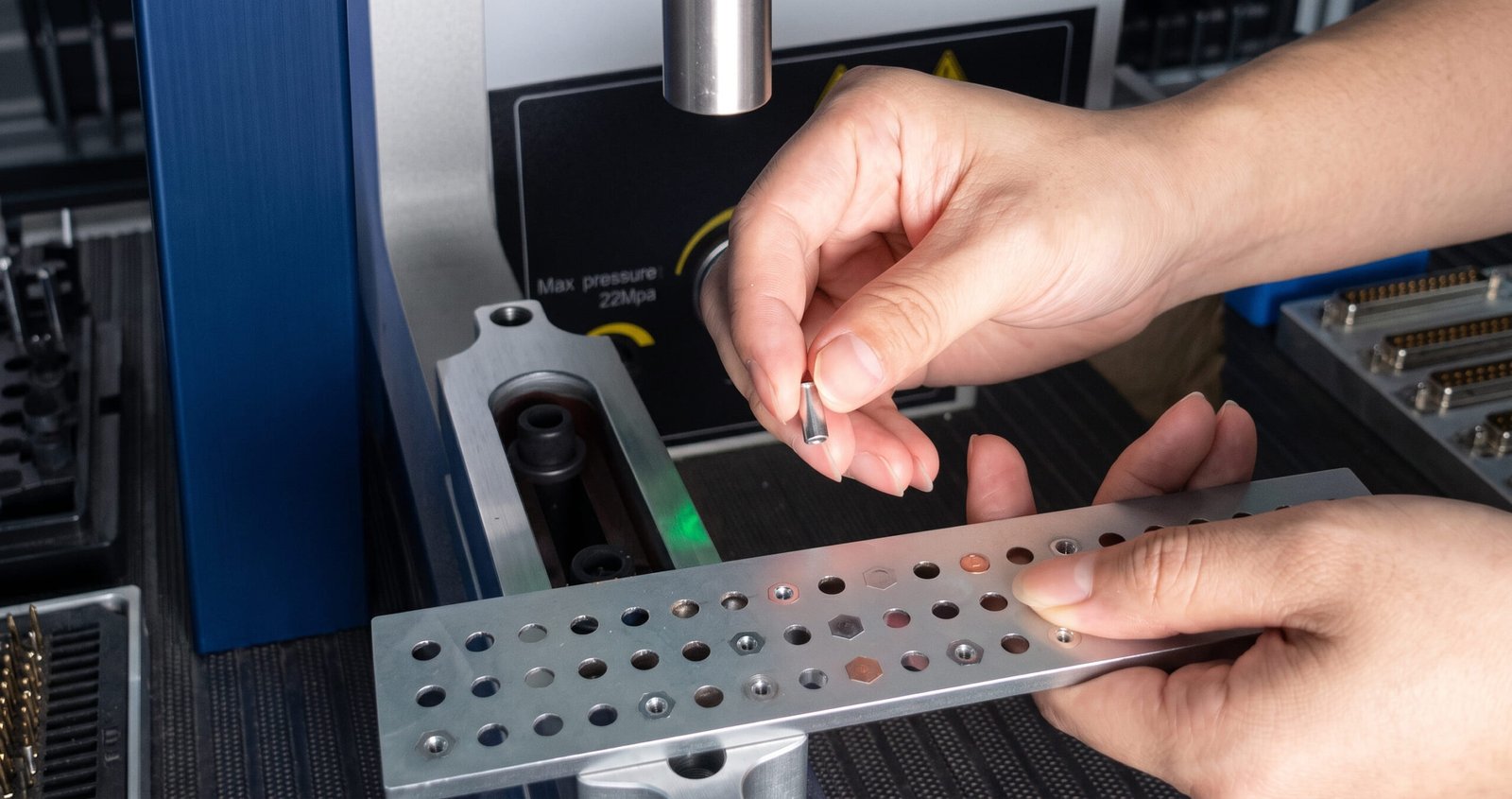
TENGHUI provides hardware insertion services for custom sheet metal parts, enclosures, panels, brackets, chassis, and fabricated assemblies.

Self-clinching nuts, studs, standoffs, rivet nuts, threaded inserts, and blind rivets can be installed according to your drawing and assembly requirements. Each application is reviewed based on the sheet material, thickness, hole dimensions, edge distance, installation direction, and required fastener performance.

✅ All Design Uploads Are Secure & Confidential 
sheet matel Hardware Insertion

Hardware Insertion for Sheet Metal Parts

Hardware Insertion Durable Threads

Thin sheet metal often cannot provide enough thread engagement for a reliable tapped hole. Installed hardware creates durable threads, fixed mounting points, or permanent joints without increasing the overall material thickness.

01

Create Reusable Threads

Establish strong, wear-resistant metric or imperial threads directly in thin sheet metal.

02

Reduce Loose Nuts & Components

Eliminate loose hardware pieces and separate loose assembly components during maintenance.

03

Simplify Final Product Installation

Streamline assembly steps and speed up integration for operators and technicians.

04

Provide Fixed Mounting & Spacing

Ensure precise standoffs, stable mounting points, and accurate component clearance.

05

Support Repeatable Assembly

Deliver consistent structural reliability across prototypes and high-volume production batches.

06

Avoid Unnecessary Welding

Replace complex welding methods with clean mechanical fastening when more suitable.

Hardware Insertion Capabilities

Hardware Capabilities Fastener Integration

Professional hardware insertion creates strong, reliable threads and permanent fixing points in thin sheet metal. Review the complete specifications and design requirements for each fastener type below.

01

Self-Clinching Nuts

Core Function: Create strong, reusable female threads in thin sheet metal. Commonly used in enclosures, control panels, chassis, brackets, and equipment housings.
Design Requirements: The sheet material, hardness, thickness, mounting-hole diameter, and minimum edge distance must match the selected fastener specification.

02

Self-Clinching Studs

Core Function: Provide a permanently mounted male thread for attaching components without requiring a separate bolt.
Applications: Suitable for mounting circuit boards, covers, cable brackets, electrical components, and internal assemblies.

03

Self-Clinching Standoffs

Core Function: Create a fixed spacing and threaded mounting point in a single installed component.
Applications: Typical applications include PCB mounting, electronic enclosures, display equipment, control systems, and layered sheet metal assemblies.

04

Rivet Nuts & Threaded Inserts

Core Function: Provide load-bearing threads in thin sheets, hollow sections, and enclosed parts where conventional tapping is unsuitable.
Accessibility: Because installation can be performed from one side, rivet nuts are useful for cabinets, tubes, frames, enclosures, and assembled structures with limited rear access.

05

Blind Rivets

Core Function: Permanently join two or more sheet metal components when access is available from only one side.
Applications: Commonly used for covers, panels, brackets, ducts, cabinets, and lightweight assemblies where welding or removable fasteners are unnecessary.

Common Sheet Metal Applications

Industry Applications

Common Sheet Metal Applications

Electronic Enclosures & Chassis
Protective housings with integrated threaded inserts.
Electrical Cabinets & Control Boxes
Robust cabinets equipped with secure hardware.
Equipment Panels & Access Covers
Service-ready removable panels and covers.
Mounting Brackets & Support Frames
Structural frameworks with precise spacing.
PCB Mounting Structures
Specialized sheet metal bases for circuit boards.
Machinery Guards & Housings
Safety enclosures built to withstand vibration.
HVAC & Ventilation Components
Air handling ducts and louvers joined securely.
Battery & Power-System Enclosures
Heavy-duty housings with reliable grounding.
Custom Fabricated Assemblies
Tailored multi-panel structures combining cutting, bending, welding, and hardware insertion.

Selecting the Appropriate Hardware

Hardware Selection

Selecting the Appropriate Hardware

Fastener selection should be based on the required thread, sheet material, loading condition, assembly method, corrosion environment, and production quantity.

Hardware Type Typical Purpose Important Design Factors
Self-clinching nut Reusable female thread Sheet hardness, thickness, hole size and edge distance
Self-clinching stud Permanently mounted male thread Stud length, thread size, installation direction and clearance
Self-clinching standoff Fixed spacing and threaded mounting Standoff height, thread type, sheet thickness and assembly space
Rivet nut Thread in thin or enclosed components Grip range, hole size, head style, torque and access
Blind rivet Permanent sheet metal joint Rivet diameter, grip range, material combination and joint access

Supported Sheet Metal Materials

Assembly Materials Compatibility & Selection

Sheet metal assemblies can be manufactured from a wide variety of engineering metals. When different metals are combined in one assembly, material compatibility, welding method, fastener material, surface treatment, and galvanic corrosion should be considered during design review.

Material Available Types Assembly Considerations
Aluminum 5052 5754 5083 6061 Lightweight, corrosion-resistant material widely used for enclosures, brackets, and structural frames.
Stainless Steel SUS301 SUS304 SUS316 Offers high strength, excellent corrosion resistance, and clean cosmetic finishes for demanding environments.
Cold-Rolled Steel SPCC DC01 DC05 Features smooth surface quality and good formability, ideal for general panels, trays, and chassis.
Carbon Steel SPHC Q235 Q355 Cost-effective structural material providing high mechanical strength for heavy-duty assemblies and frames.
Electro & Hot-Dip Galvanized Steel SECC SGCC Coated with zinc for enhanced corrosion protection while maintaining smooth surface aesthetics.
Copper & Brass Selected applications Available for applications requiring high electrical conductivity or decorative aesthetic finishes.
Titanium Reviewed projects Specialized high-performance metal for reviewed prototype and low-volume aerospace or medical projects.

Design Guidelines for Hardware Insertion

Design Guidelines Hardware Insertion

Following strict design rules for fastener specification, hole preparation, edge distance, and manufacturing sequence ensures optimal structural integrity and retention strength in sheet metal assemblies.

01
Specify the Exact Fastener
Include the manufacturer, part number, thread size, material, finish, and installation direction on the 2D drawing or BOM. Equivalent hardware requires customer approval.
02
Use the Recommended Mounting Hole
Mounting holes must follow the fastener manufacturer’s spec. Do not determine hole diameter solely from nominal thread size. Avoid countersinking or chamfering unless required.
03
Maintain Sufficient Edge Distance
Hardware too close to an edge, bend, or cutout may deform the sheet or reduce retention. Minimum edge distance depends on fastener type, size, material, and thickness.
04
Consider the Manufacturing Sequence
Some hardware must be installed before bending, others after forming or finishing. We review the full sequence to reduce interference and protect threads and surfaces.
05
Identify Performance Requirements
If the joint has specific torque, push-out, pull-through, grounding, sealing, or corrosion-resistance requirements, identify them on the drawing for engineering review.

Hardware Insertion Quality Control

Quality Control Inspection & Testing

Rigorous inspection protocols ensure every inserted fastener meets strict mechanical and visual standards. Advanced testing options are available upon specification before quotation.

Standard Visual & Dimensional Inspection

✓
Correct Fastener Type & Quantity Verify part numbers, thread sizes, and counts match documentation.
✓
Installation Position & Direction Confirm precise coordinates and correct orientation.
✓
Proper Seating & Visible Flushness Check heads and shoulders are fully seated and flush without gaps.
✓
Loose, Tilted, or Rotating Hardware Inspect for improper pressing, misalignment, or spinning components.
✓
Thread Condition & Assembly Fit Ensure threads are clean, undamaged, and smooth for mating.
✓
Sheet Deformation Around Area Examine metal for excessive bulging, buckling, or distortion.
✓
Critical Dimensions After Insertion Validate key dimensional tolerances and clearances across panels.
Advanced Testing

Performance & Mechanical Testing

Thread gauging, torque testing, push-out testing, or pull-out testing can be evaluated when these requirements are specified before quotation.

Thread Gauging
Torque Testing
Push-out Testing
Pull-out Testing

Files Required for Quotation

Quotation Files Requirements & Info

To ensure a fast and accurate hardware insertion quote, please provide complete design and technical documentation. If fasteners are not yet selected, our engineering team can assist with practical fastening options.

Required Technical Documentation for Quotation

01
3D CAD Model Standard 3D files for geometry evaluation and structural clearance.
02
2D Manufacturing Drawing Precise fabrication details, hole specs, and tolerances.
03
Sheet Material & Thickness Exact metal alloy grade and gauge thickness.
04
Fastener Manufacturer & Part No. Exact brand, series, and part numbers for sourcing.
05
Thread Size & Installation Direction Standard/metric thread dimensions and orientation.
06
Required Quantity Batch sizes and estimated annual volume for cost optimization.
07
Surface-Finishing Requirements Post-processing, plating, anodizing, or powder coating specs.
08
Critical Dimensions & Inspection Key functional dimensions and special quality control needs.
💡
Hardware Not Yet Selected? If the hardware has not yet been selected, send the assembly requirements and intended use. TENGHUI can review practical fastening options based on the part design.

Sheet Metal Hardware Insertion FAQs

1. What types of hardware can TENGHUI install?

Available options include self-clinching nuts, studs, standoffs, rivet nuts, threaded inserts, and blind rivets. Other specified hardware can be reviewed according to the drawing.

2. Can hardware be installed in aluminum and stainless steel?

Yes, but the fastener must be compatible with the sheet material, hardness, and thickness. The exact combination is reviewed using the selected fastener’s technical specification.

3. What is the difference between a self-clinching nut and a rivet nut?

A self-clinching nut is pressed into a prepared hole and normally requires access for press tooling. A rivet nut is mechanically collapsed inside the hole and can be installed from one side, making it suitable for hollow or enclosed structures.

4. Should hardware be installed before or after bending?

It depends on the hardware location, press-tool access, bend clearance, and risk of interference. Hardware near a bend is often installed after forming, while inaccessible locations may require installation earlier in the fabrication sequence.

5. Can hardware be installed after powder coating or anodizing?

Some hardware can be installed after finishing, but others are better installed beforehand. The correct sequence depends on the fastener type, finish thickness, cosmetic requirements, grounding needs, and risk of coating damage.

6. Can you use customer-specified PEM® or equivalent fasteners?

Yes. Include the manufacturer and part number on the drawing or bill of materials. Any proposed equivalent should be confirmed before production.

7. Can you verify pull-out strength or installation torque?

Testing can be evaluated when the required load, torque, test method, sample quantity, and acceptance criteria are provided before quotation.

8.How accurate is the hardware position?

Hardware location is primarily controlled by the accuracy of the prepared mounting hole. Final positional requirements may also be affected by forming, installation force, and sheet deformation. Critical locations and datums should be identified on the 2D drawing.

Send Us a Message

Once we receive your design files, our senior manufacturing engineers will manually perform a comprehensive DFM review and deliver an accurate, optimized quote within 24 hours.